FHJC Testing Investigation Yielded Evidence of Race Discrimination
U.S. District Judge William H. Pauley III has signed an agreement resolving a housing discrimination lawsuit involving 43-unit rental building in Brooklyn. The complaint, filed in January 2015 by the Fair Housing Justice Center (FHJC) and three African American testers, alleged that a rental agent for FGC 710 Avenue S. LLC engaged in racially discriminatory rental practices. The complaint alleged, among other things, that African American testers were quoted higher rents and security deposits or were told no apartments were available while the same agent quoted lower rents and security deposits and provided information about available apartments to comparably qualified white testers.
As part of the injunctive relief in this case, the defendants agreed to adopt, post, and distribute a fair housing policy, require employees and agents to participate in fair housing training, ensure that available rental units are publicly advertised, and require uniform standards and procedures for showing available apartments and dispensing information about them. The order provides that the defendants will maintain rental records and the FHJC will be able to monitor compliance with the agreement for a period of four years. Finally, the defendants agreed to pay the plaintiffs $95,000 for damages and attorney’s fees.
FHJC Executive Director Fred Freiberg commented, “This is yet another example of how testing is often the only way to learn whether landlords are providing the same information, quoting the same prices, offering the same service, and affording the same treatment to people of different races.” Freiberg added, “Without testing, most racial discrimination in housing would go undetected and unchallenged
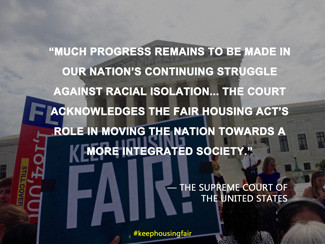
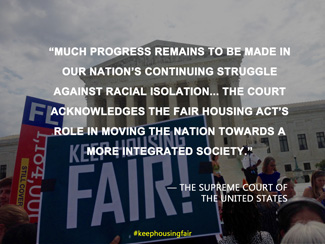
WASHINGTON, DC –Today the US Supreme Court gave the civil rights community a resounding victory in the long-awaited decision on Texas Department of Housing and Community Affairs v. The Inclusive Communities Project, Inc. The Court held “that disparate-impact claims are cognizable under the Fair Housing Act upon considering its results-oriented language, the Court’s interpretation of similar language in Title VII and the ADEA, Congress’ ratification of disparate-impact claims in 1988 against the backdrop of the unanimous view of nine Courts of Appeals, and the statutory purpose.”
The 5-4 ruling confirms the continuing importance of disparate impact as a tool for addressing housing discrimination under the Fair Housing Act and reaffirms 45 years of legal precedent, including 11 appellate court rulings. Today’s decision also strengthens the bipartisan commitment made in 1968, and again in 1988, to ensure that Americans are protected from housing discrimination. The Fair Housing Center of the Greater Palm Beaches and NFHA will continue to work with its partners in the civil rights, housing, lending and insurance industries to advance housing opportunities for everyone.

Today, the Fair Housing Center of the Greater Palm Beaches (FHC), along with the National Fair Housing Alliance (NFHA) and 18 other fair housing organizations announced the filing with HUD of a housing discrimination complaint against Fannie Mae, one of the largest owners of foreclosed homes in the United States.
The FHC staff investigated 24 Fannie Mae Palm Beach County REOs in 2014.
-
44% of the REO properties in communities of color had trash or debris on the premises
-
39% of the REO properties in communities of color had overgrown or dead shrubbery
-
33% of the REO properties in communities of color had unsecured, broken, or boarded doors
It is absolutely unacceptable that Fannie Mae continues to rod black and Latino neighborhoods, the most devastated by the economic meltdown of 2008, of hard earned wealth,” stated Vince Larkins, President and CEO of the FHC.
“These working-class communities, where all the properties we investigated reside, bore the brunt of the financial crisis and continue to do so today. They need not have the suffer the added burden of housing discrimination,” he further stated.

The Fair Housing Act makes it illegal to discriminate based on race, color, national origin, religion, sex, disability, or familial status, as well as on the race or national origin of residents of a neighborhood. The Act applies to housing and housing-related activities, which includes the maintenance, appraisal, listing, marketing, and selling of homes.
Evidence gathered from 2010 through April 2015 documents an ongoing pattern and practice of discrimination by Fannie Mae. Currently, NFHA and its partners have investigated 2,106 REO properties owned by Fannie Mae in 34 metropolitan areas encompassing 129 cities across the United States.
The FHC and fair housing organizations nationwide investigated the maintenance and marketing of REOs for 39 different types of deficiencies that affect home value. Fannie Mae properties in communities of color had broken doors and windows, unlocked doors and windows allowing access to the home, excessive litter, dead or overgrown lawns, dead animals or live animals on the property, and other major deficiencies. Conversely, most Fannie Mae properties in predominantly White communities did not. These problems are simple to fix and are the responsibility of Fannie Mae.
“Fannie Mae is wreaking havoc on middle- and working-class communities of color nationwide through a pattern of neglect that is frankly appalling,” said Shanna L. Smith, President and CEO of NFHA. “Fannie Mae’s failure to take care of its massive foreclosure inventory in African American and Latino neighborhoods further destabilizes the communities hardest hit by the foreclosure crisis, in clear contradiction of its congressional charter, federal fair housing laws, and its obligation to affirmatively further fair housing. This systematic failure also creates health and safety hazards, contributes to blight, and places an unfair burden on neighbors and city governments to clean up the problem.”
“Since 2009, NFHA has made efforts to work with the Government Sponsored Enterprises(“GSEs”) to correct their practices. The GSEs have a legal responsibility to treat all neighborhoods fairly.” Smith said, “Freddie Mac looked into its practices and made good faith efforts to correct its business model, but Fannie Mae refused to take responsibility for its neglect in communities of color. The difference between Freddie and Fannie properties is striking. We now rarely find disparities in Freddie Mac’s inventory. Fannie has to take responsibility.” Sheadded, “Fannie Mae has not only ignored the problem but has continued to award millions ofdollars in new contracts to the same asset management companies that engaged in this discriminatory behavior. We have filed this complaint after having exhausted every possible means we could think of to get Fannie Mae to abide by the law and work with us to re-stabilize the damaged communities.”

NATIONWIDE STATISTICS:
Full national statistics, data for individual cities and HUD complaint available at: www.nationalfairhousing.org
Summary of Findings:
-
49.5 percent of the REO properties in White communities had fewer than 5 deficiencies, while only 24.4 percent of the REO properties in communities of color had fewer than 5 deficiencies.
-
22.1 percent of the REO properties in communities of color had 10 or more deficiencies, while only 8.0 percent of the REO properties in predominantly White communities had 10 or more deficiencies.
Highlights of Significant Racial Disparities:
-
40.6 percent of the REO properties in communities of color had a broken, boarded, or unsecured window, while only 21.2 percent of the REO properties in White communities had the same problem.
-
38.5 percent of the REO properties in communities of color had trash or debris on the premises, while only 15.1 percent of the REO properties in White communities had the same problem.
-
29.8 percent of the REO properties in communities of color had holes in the structure of the home, while only 13.9 percent of the REO properties in White communities had the same problem.
-
27.3 percent of the REO properties in communities of color had wood rot, while only 17.8 percent of the REO properties in White communities had the same problem.
-
23.9 percent of the REO properties in communities of color had unsecured, broken, or boarded doors, while only 11.6 percent of the REO properties in White communities had the same problem.
-
21.7 percent of the REO properties in communities of color had exposed or tampered-with utilities, while only 9.7 percent of the REO properties in White communities had the same problem.
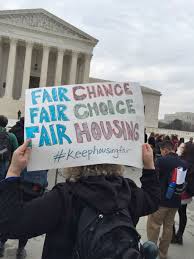
On January 21, 2015, as oral arguments began, representatives from organizations which filed amicus briefs, the NAACP Legal Defense Fund, the National Fair Housing Alliance and the American Civil Liberties Union, rallied in front of the Supreme Court about the case Texas Department of Housing and Community Affairs v. The Inclusive Communities Project, Inc.
With this case, the justices will probably decide this summer on a key component of the Fair Housing Act, disparate impact, a theory which safeguards the right to a fair shot for everyone. Where you live determines where you work and how you get there, your access to healthcare, and the school your child attends. Unfortunately, policies and practices still exist that – intentionally or unintentionally – keep some people out of housing they can afford simply because of who they are.
While the country has made great strides in advancing fairness in the housing sector, segregation persists and there is still more work to be done. Everyone benefits from a housing market free from discrimination where the full participation of all Americans is possible.Additionally, from a business standpoint the disparate impact theory helps us maintain open markets free from discrimination – a critical component to the prosperity of America’s future. Discrimination disrupts our economy, causing inefficiency and instability by constraining the full economic participation of all hard-working Americans.
Examples of Disparate Impact:
-
An apartment complex only allows people with full-time jobs. This bars disabled veterans and other people with disabilities who may not be able to work full-time, even though they can afford the apartment. The complex could instead consider all income to assess someone’s ability to afford rent.
-
A city decides to prohibit all housing that would be affordable to working-class people, and that has the effect of excluding most or all people of color in that region. If the city cannot show a valid reason for its policy, or if a more fair and effective alternative is available, then the policy would have to be set aside under the disparate impact approach.
-
A lender has a policy of allowing its loan officers to overcharge consumers at the loan officer’s discretion. The result is that women are charged higher prices than their male counterparts-even though both have the same credit profiles. In a case like this, the lender would have to abandon the discretionary pricing policy and take steps to insure that women are not over-charged for lending products and services.
Copyright © Fair Housing Center of the Greater Palm Beaches 2013. All Rights Reserved. 1-877-910-FAIR (3247)
 0
0